In
our practice of Renaissance martial arts we have developed
and instituted certification ratings for becoming adept in each weapon
and fighting skill (i.e., longsword, dagger, staff weapons, short
sword & buckler, sword & dagger, rapier, rapier & dagger,
polaxe, Ringen, etc.).
 Scholar:
The general Scholar rating represents the student gaining
the absolute minimal core elements necessary for serious study of
Renaissance martial arts to develop basic practice skills from the
historical teachings. It revolves around becoming adept
with the longsword in the foundational drills and exercises required
for training in the ARMA System. Competency at the Scholar
level requires approximately 1-3 years of active study by the student. The
term "scholar," originally meaning student, also refers to any member
practitioner in ARMA, regardless of capability or training. It is
generally used as a term of courtesy between practitioners of all
levels. In official ARMA ranking however, admittance to the first
rate of Scholar is awarded upon successful completion of an introductory
course of study and testing for evaluation as a longsword
adept. Scholar:
The general Scholar rating represents the student gaining
the absolute minimal core elements necessary for serious study of
Renaissance martial arts to develop basic practice skills from the
historical teachings. It revolves around becoming adept
with the longsword in the foundational drills and exercises required
for training in the ARMA System. Competency at the Scholar
level requires approximately 1-3 years of active study by the student. The
term "scholar," originally meaning student, also refers to any member
practitioner in ARMA, regardless of capability or training. It is
generally used as a term of courtesy between practitioners of all
levels. In official ARMA ranking however, admittance to the first
rate of Scholar is awarded upon successful completion of an introductory
course of study and testing for evaluation as a longsword
adept.
Free-Scholar: The Free Scholar rating
reflects a deeper commitment of study on the part of the student
as well as a higher degree of understanding of core concepts and
principles. It represents training and demonstrated progress in
application of teachings. Expect a minimum of 3-5 years committed
study to acquire working knowledge of theories and skills at this
level. additionally, the student will have publicly Played his Prize
against his peers to earn Free Scholar ranking with different weapons. A
Free Scholar is a student that has progressed to where they show
sincere commitment to learning and developing real skill. They have
been tested in extended free-play and have demonstrated significant
understanding and ability at more than one weapon and combat skill.
Free Scholars act as assistant instructors within ARMA and can raise
other members up to Scholar rank.
 Provost:
The Provost rank is the senior practitioner or instructor level
earned by achieving multiple weapon rankings as a Free-Scholar. A
Provost is a highly skilled and knowledgeable practitioner in multiple
weapons plus appropriate unarmed techniques. They are dedicated
practitioners seeking mastery level who have been tested in Prize
Playing for each weapon they are ranted in. Provosts act as the
primary instructors within ARMA and can teach up to Free Scholar
rank. As in the historical Schools of Defence, the process
of earning Provost may take 5-7 years, given our high standards
and the fact the recovery of these lost teachings and revival of
these extinct fighting disciplines is a continually evolving craft. Provost:
The Provost rank is the senior practitioner or instructor level
earned by achieving multiple weapon rankings as a Free-Scholar. A
Provost is a highly skilled and knowledgeable practitioner in multiple
weapons plus appropriate unarmed techniques. They are dedicated
practitioners seeking mastery level who have been tested in Prize
Playing for each weapon they are ranted in. Provosts act as the
primary instructors within ARMA and can teach up to Free Scholar
rank. As in the historical Schools of Defence, the process
of earning Provost may take 5-7 years, given our high standards
and the fact the recovery of these lost teachings and revival of
these extinct fighting disciplines is a continually evolving craft.
 Under
the Member
Training Program (MTP) a student would first seek ranking as a Scholar
(longsword adept) then as a Free-Scholar, consisting of further specialization
in additional weaponry and skills, such as side-sword, rapier, sword
& buckler, dagger, Ringen, and pole-arms. Under
the Member
Training Program (MTP) a student would first seek ranking as a Scholar
(longsword adept) then as a Free-Scholar, consisting of further specialization
in additional weaponry and skills, such as side-sword, rapier, sword
& buckler, dagger, Ringen, and pole-arms.
Keep
in mind that, standards for Free Scholar are minimal requirements
that must be met for recognition of rank. But, Study Groups are free
to add on any other additional elements they deem appropriate, so
long as the core certification requirements are met. Provosts also
have authority to advance their own students to the general rating
upon approval. As part of advancement, ranked members are also expected
to assist their local fellow members in study and curriculum development.
 Scholars
begin typically study with the longsword, then are rated
later in other individual weapons and proficiencies. Progressing
between Rates from Scholar to Free Scholar and Senior Free Scholar,
and then on to Provost rankings, is achieved only through testing.
This consists of physical demonstration with particular weapons, an
oral quiz, and finally an extensive free-sparring challenge with various
weapons against other students (both junior and senior). But, ARMA
students are not consumed with advancing in rank. They are not focusing
on or aiming at that "next belt level". When a senior student feels
ready and has the prowess to be recognized, they then will be progressed
to the next Rate. It is then an earned honor and privilege of recognition
by ones peers. After all, Masters
of Defence in the Medieval and Renaissance eras were often only those
teachers who had proven their skills and knowledge to thereby earn
the respect and acclaim of their students. Scholars
begin typically study with the longsword, then are rated
later in other individual weapons and proficiencies. Progressing
between Rates from Scholar to Free Scholar and Senior Free Scholar,
and then on to Provost rankings, is achieved only through testing.
This consists of physical demonstration with particular weapons, an
oral quiz, and finally an extensive free-sparring challenge with various
weapons against other students (both junior and senior). But, ARMA
students are not consumed with advancing in rank. They are not focusing
on or aiming at that "next belt level". When a senior student feels
ready and has the prowess to be recognized, they then will be progressed
to the next Rate. It is then an earned honor and privilege of recognition
by ones peers. After all, Masters
of Defence in the Medieval and Renaissance eras were often only those
teachers who had proven their skills and knowledge to thereby earn
the respect and acclaim of their students.
|
 The
ARMA has always been unique in its attitude toward historical
fencing skills, in that we are not concerned with hierarchy
of titles or earning wins in competitive tournaments. We’re
not obsessed with hierarchy, structure, or etiquette. We believe
that real ability is self-evident and that real skill transcends
any artificially imposed system of labeling. Titles alone do
not confer skill and degrees are not an end in themselves. The
ARMA has always been unique in its attitude toward historical
fencing skills, in that we are not concerned with hierarchy
of titles or earning wins in competitive tournaments. We’re
not obsessed with hierarchy, structure, or etiquette. We believe
that real ability is self-evident and that real skill transcends
any artificially imposed system of labeling. Titles alone do
not confer skill and degrees are not an end in themselves.
Each
individual weapon proficiency or skill certification must be
earned separately and students may choose what areas and disciplines
they want to focus on. Thus, a Scholar might be rated
as proficient in longsword or at sword & buckler, but would
later have to be rated again in each at the Free Scholar rank.

Another Scholar
might be proficient in sword & buckler and also sword
& dagger, but would have to be rated for each again as a
Free Scholar if they later achieved that rank. Similarly, a
Free Scholar might be rated as proficient in longsword, and
with the dagger alone, but not in rapier or vice versa. Another
Free Scholar might be proficient in sword & buckler and
Ringen, but not spear or the rapier.
|
Historically,
within the Schooles
of Defence or fighting guilds
each student had a set minimum number of years required between
advancement and was publicly tested in each weapon by "Playing
their Prize" (publicly demonstrating
their skill in formal sparring bouts against their fellow students
and teachers). From our beginnings, the ARMA has worked
to revive this tradition for testing of our fighters. In contrast
to the historical events, fewer weapons are so far included
in ours at any one event and the time span between testing is
not as firm established. Given the tentative nature of exploration
into this subject, it is a factor of each individual student’s
aptitude, dedication, and martial improvement. It is not a quick
process. Every student should expect their progress to take
years. It should be understood that the ARMA does not pursue
either a simplistic or light-hearted effort. |
Skill
Proficiency Certification
The
ARMA’s objectives are to redevelop and teach authentic
Medieval and Renaissance self-defense methods from the historical
sources. To do this we rate students in individual proficiencies following
the practice standards established in our training curriculum.
To be certified
with a rating for any individual skill proficiency consists of demonstrating
competency in three areas: scholarship (history and theory), principles,
and techniques. These are confirmed through oral exam, physical
demonstration or technical display, and free-play (sparring bouts).
|
 The
longer you attend and study and practice, the farther you’ll
go. If you stick around long enough you get rated in different
weapons. It’s that simple. But, unique to the ARMA is
that unlike other martial arts, rates and proficiencies can
be lost if at a later date the student fails to maintain the
perquisite level of skill. Skill certification is not earned
for life. To be retained, proficiencies must re-certified every
5 years. In other words,
unlike most martial arts today, we place an "expiration date"
of sorts on our ranking. They are only as current as their last
recertification. The
longer you attend and study and practice, the farther you’ll
go. If you stick around long enough you get rated in different
weapons. It’s that simple. But, unique to the ARMA is
that unlike other martial arts, rates and proficiencies can
be lost if at a later date the student fails to maintain the
perquisite level of skill. Skill certification is not earned
for life. To be retained, proficiencies must re-certified every
5 years. In other words,
unlike most martial arts today, we place an "expiration date"
of sorts on our ranking. They are only as current as their last
recertification.
Qualified
individuals can currently become ARMA certified in several primary
skill areas: longsword, sword & buckler (with arming
sword), single-sword (falchion or arming sword), side-sword &
dagger, rapier (& dagger), Ringen, dagger, staff, spear,
polaxe, or halberd. Testing approval consists of recommendation from
the student's chief ARMA instructor for the tested skill or the
student's local Study Group instructor, and, at a minimum, completion
of the ARMA Member Training
Program 1.0 seminar.
|
In
a very real way, there can be no designation more personal than
for each individual, no matter who they are, to accept for themselves
the simple title "student of the sword." To be also a "scholar"
of the "knightly Art of Arms", in the true sense of research and
learning, is something else that each student must pursue on their
own. Serious ARMA students are those who realize this is a martial
art. As such it is an activity that demands discipline and eventually
can affect your physique and your character for the better. Training
is a path not a destination. |
Scholar
Evaluation - sample criteria for Longsword Adept:
Certification
in the longsword consists of three tests whose objectives must be
successfully met in order to be awarded ranking. All test parts must be
passed over one session. The objective is to qualify whether or
not the student meets the minimum skill standards that the ARMA has set
for this craft.
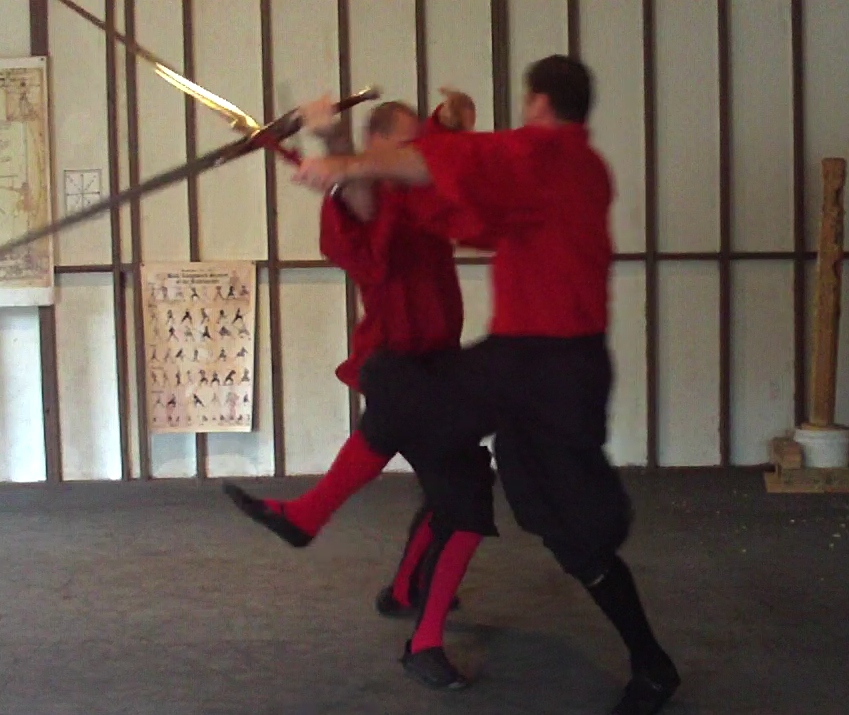 1.
Verbal Examination - Describe in short answers longsword history,
forms, anatomy and parts. Describe names, dates, and significance of
the major source literature for the weapon. Demonstrate general
knowledge of terms, concepts, and principles. Explain the basis of the
ARMA approach to study and methodology for training as well as our
philosophy for reconstructing historical fencing skills. 1.
Verbal Examination - Describe in short answers longsword history,
forms, anatomy and parts. Describe names, dates, and significance of
the major source literature for the weapon. Demonstrate general
knowledge of terms, concepts, and principles. Explain the basis of the
ARMA approach to study and methodology for training as well as our
philosophy for reconstructing historical fencing skills.
2. Floryshe Display - Demonstrate a spontaneous practice routine of assorted strikes, wardings, covering, and motion
in a prepared yet unstructured manner using proper form, speed,
flow, coordination, vocalization, and intent. A variety of fundamental
actions and techniques should be performed with good tempo and fighting
rhythm for approximately 20 to 40 seconds. Basic stances and cuts must
be included along with key footwork.
3. Basic
Techniques - Demonstrate proficiency in primary cutting exercises,
stance transitions, and stepping motions performed at proper speed with
both good intent and control. This may be waived if included in the
floryshe portion.
 For
later Free-Scholar rating a formal Prize Playing challenge is added.
Prior to this, the student candidate's skill in sparring must have been
previously demonstrated to a considerable degree using wooden or blunt
steel weapons, including awareness of contact and control against
opponents of all experience levels. They must be capable of safely
executing techniques in free-play against fellow students and
instructors in a manner that reveals control in the tactical
application of actions. They must be able to face dissimilar weapons
and opponents of equal or lesser rating. Depending on the number
of
participating fighters, each individual bout may end after any one
single good hit or continue on for three separate clean hits. Bouts are
followed consecutively by one another until all have been completed in
the given time. For
later Free-Scholar rating a formal Prize Playing challenge is added.
Prior to this, the student candidate's skill in sparring must have been
previously demonstrated to a considerable degree using wooden or blunt
steel weapons, including awareness of contact and control against
opponents of all experience levels. They must be capable of safely
executing techniques in free-play against fellow students and
instructors in a manner that reveals control in the tactical
application of actions. They must be able to face dissimilar weapons
and opponents of equal or lesser rating. Depending on the number
of
participating fighters, each individual bout may end after any one
single good hit or continue on for three separate clean hits. Bouts are
followed consecutively by one another until all have been completed in
the given time.
For
a list of seminar courses within our Member
Training Program go here.
|


