|
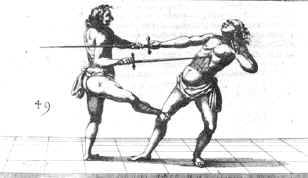
|
Chapter Contents:
|
| I |
Violence in the classroom: Medieval
and Renaissance masters of arms |
| II |
The notation and illustration of
movement in combat manuals |
| III |
Foot combat with swords: myths and
realities |
| IV |
Sword fighting: vocabulary and
taxonomy |
| V |
Staff weapons |
| VI |
Bare hands, daggers, and knives |
| VII |
Arms and armour |
| VIII |
Mounted combat (1): jousting with
heavy lance |
| IX |
Mounted combat (2): cut, thrust and
smash |
| X |
Duels, brawls and battles |
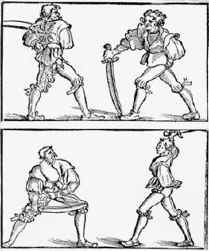
|
Exclusive
Excerpts from
The Martial Arts of Renaissance Europe
Introduction
Both the significance of these arts,
and the fact that they have been largely ignored by historians, are
easily established. While nobody has ever doubted the importance of
expertise in the handling of weapons to the knightly classes of
medieval Europe, our knowledge of what these skills were and how they
were acquired remains generalized and inexact. More remarkably, the
same holds true of the Renaissance when, despite the constant
reiteration by humanist educational theorists of the value of training
the body as well as the mind, we still know next to nothing about the
practice of physical education and the provision of combat training for
youths.
Furthermore, the techniques of
personal violence were studied not only by emperors, kings, and
princes, but also by their most humble subjects. The carrying and the
use of lethal weapons was normal throughout the social hierarchy.
From the late thirteenth to the
mid-nineteenth centuries, artists worked with masters of arms trying to
record the techniques of personal combat.
... the masters sought to bring their
skills to a wider audience...recording series of movements and of
conveying information…systems of movement notation and illustration.
…and it is largely because of their
endeavours to give some sort of permanence to their ideas that we are
able to attempt a reconstruction of a very important but relatively
little-studied subject in the history of ideas – the martial arts of
renaissance Europe.
But it is still necessary to
establish the martial arts within the broader contexts of intellectual,
military, and art history while establishing more precisely what these
activities were, and how they were systematized.
But their neglect [by historians]
still constitutes an historiographical curiosity. The only serious
treatment of these matters has been by historians of fencing, by
students of arms and armour and, more recently, by re-enactors and
enthusiasts for historical modes of combat. Unfortunately, historians
of fencing were at their most active a century ago when they confined
themselves principally to tracing the evolution of swordsmanship
towards a wholly notional ideal constituted by their own practice;
while, in any case, sword play was only one part of the many activities
which together constituted the martial arts of the Renaissance.
Specialists in arms and armour have carried out much meticulous
research but, in their case, the centre of interest has inevitably been
more with artefacts than activities. Serious modern re-enactors, on the
other hand, while frequently aware of a far wider range of combat
techniques than the old fencing historians and far more pragmatic in
their approach to physical action than the armour specialists, still
tend to base their reconstructions upon a limited number of primary
sources – although this situation is changing rapidly."
|
From
Chapter 4
La Communicativa
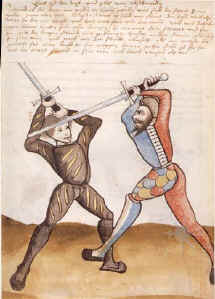 The
problem facing the teacher, admired in hypothesis by Marcelli and Hope,
is to a large extent the central issue of my own study. While most
masters agreed that there was no substitute for practical demonstration
by an instructor, many of them still tried to convey the essentials of
their art in books and found, inevitably, that this was a difficult
thing to do. Indeed, without some sort of agreed technical vocabulary
and taxonomic conventions, it was almost an impossibility. The
problem facing the teacher, admired in hypothesis by Marcelli and Hope,
is to a large extent the central issue of my own study. While most
masters agreed that there was no substitute for practical demonstration
by an instructor, many of them still tried to convey the essentials of
their art in books and found, inevitably, that this was a difficult
thing to do. Indeed, without some sort of agreed technical vocabulary
and taxonomic conventions, it was almost an impossibility.
Unfortunately, since all treatises
had to be studied by their readers without benefit of the authors’
‘motions’, how was comprehensibility to be achieved?
Marco Docciolini must have expressed
the misgivings of many when he explained that while, in his own book,
he had tried to describe as clearly as was within his power the rules
and methods necessary for the exercise of the sword alone or
accompanied by some other arm, he knew that ‘having to describe many
minutiae and many particular things concerning this art, it is almost
impossible to represent it with the clarity that it perhaps demands’.
The majority of masters thought
otherwise and preferred straightforward exposition although, whatever
the literary form used, most authors would have agreed with Marcelli
that their principal aim was to achieve clarity. It is also evident
that they believed it possible to achieve this: first by deducing, from
a multiplicity of sword, arm, foot and body movements, some
communicable general principles; and then, by analysing particular
actions and arranging them in sequences, to form some kind of system.
This required both practical expertise and intellectual grasp; and the
rarity of such a combination of skills was remarked by Fiore who
claimed that, out of a thousand ‘so-called masters’, you could scarcely
find four good scholars; ‘and of those four good scholars there will
not be one good master’.
Certainly all those masters who chose
to write down their views were obliged, consciously or unconsciously,
to consider the relationships not only between the theory and practice
of fencing but also between the language and content of their works;
and some believed the task to be well within their capacity. 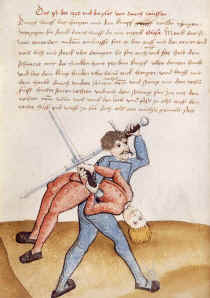
These issues may be illuminated,
somewhat paradoxically, by two examples of unintelligibility. Of these,
the first, Johann Liechtenauer’s Art of the Long Sword,
is a seminal work in the history of swordsmanship. The
fourteenth-century German master had a thorough grasp of his art,
understood how men fought, and had worked out not only general
principles of combat but also a method for instructing his disciples.
Unfortunately, his work is recorded in gnomic verses of such obscurity
that – without the key provided by the comments, elaborations and
pictorial representations bequeathed to us by his followers (and their
followers) – it would remain for ever enigmatic.
This may, in part, be due to the
deliberate obfuscation of a master reluctant to cast the pearls of a
secret art before swinish uninitiates – although a similar contempt for
‘men rustical and of vile condition’ did not prevent Filippo di Vadi
from trying hard to make his manuscript as clear as possible to
‘courtiers, scholars, barons, princes, dukes and kings’.
On the other hand, since
Liechtenauer’s verses appear to have had a mnemonic function, it is not
strange that they should be abstruse. One would scarcely remember a
mnemonic which did not leave out more than it put in. But beyond that,
Liechtenauer’s obscurity is also the result of a nomenclature and a
system of classification which fail to match the sophistication of the
combat techniques they record. In this respect, the other example of
communication failure provides an interesting comparison. The literary
remains of English masters of arms at the turn of the fifteenth and
sixteenth centuries are exiguous.
The existence of these writings can
only be due to some desire on the part of the masters to instruct
potential readers and, unlike Liechtenauer’s verses, they seem not to
have been either consciously arcane or elliptical. Face to face, and
sword in hand, these men may even have been effective teachers; but
they had no conception of what was required to explain the complexities
of movement to anybody not physically in their presence. They assume so
much knowledge, and use so many unexplained technical terms, that their
writings are now barely comprehensible.
Of course, it is possible to gloss
several of the terms and to make informed guesses about others but,
even when that has been done, no clear notion of the combat technique
can emerge because there are no relevant English texts or pictures
which would provide us with the kind of key we have for Liechtenauer.
The terminology used by these medieval English masters did not survive
in later works and, given the present state of our knowledge, much of
their meaning is simply not recoverable.
Yet the basic components of sword
combat must have been evident to anyone who considered the matter
seriously. The weapon had to be brought into action and held
effectively. The swordsman could adopt a variety of stances; move his
sword in different ways; attack an opponent with different parts of his
blade, from different angles, and aiming at different targets. He could
move in various directions, leading with either right or left foot, and
adapting his pace according to circumstances. Movements could be
performed to lure an opponent into responding in a certain way, thereby
giving opportunity for another type of assault.
And, of course, when an opponent was
himself trying to launch attacks, his blade could be either knocked
aside or deflected in such a way as to initiate one’s own
counter-attack. In other words, there were stances, positions and
targets; passes and counter-passes; cuts, thrusts and feints; parries
and ripostes. Masters of arms would have understood all this from
combat experience and from teaching; and some basic matters, such as
the different types of cut possible with a sword, were standardized
very quickly. And diagrams illustrating vertical, horizontal and
oblique strokes have featured in fencing manuals throughout their
history and were also used to clarify the handling of staff weapons.
Yet it took centuries for any uniform method of organizing all this
material to develop, and for a generally accepted language of
swordsmanship to emerge: while some crucial issues, such as getting the
sword into action and gripping it properly, were consistently
overlooked.
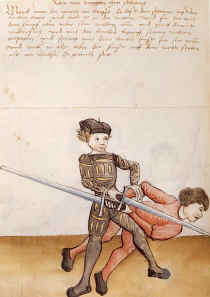
In 1389, Hanko Dšbringer explained
this last point: Here note that Liechtenauer divides a person in four
parts, as if he were to draw a line on the body from the crown of the
head down between his legs, and another line along the belt
horizontally across the body. Thus there are four quarters, a right and
a left over the belt, and also under the belt. Thus there are four
openings, each of which has particular techniques which are used
against it.
 The
system (even when presented in a disorderly fashion) was comprehensive,
intelligent and practical and it is not surprising that Liechtenauer’s
divisions, headings and nomenclature – amplified and rearranged to make
for better understanding – remained the foundation of German
swordsmanship until, in the early seventeenth century, the long sword
lost its status as the principal German weapon for personal combat. Not
only was the tiny original text constantly swollen by annotations and
explanations but later masters also relentlessly added to the list of
postures and blows so that, although Liechtenauer’s original list for
the long sword was never superseded, the number of names necessary for
understanding the combat grew to a bewildering multiplicity. The
system (even when presented in a disorderly fashion) was comprehensive,
intelligent and practical and it is not surprising that Liechtenauer’s
divisions, headings and nomenclature – amplified and rearranged to make
for better understanding – remained the foundation of German
swordsmanship until, in the early seventeenth century, the long sword
lost its status as the principal German weapon for personal combat. Not
only was the tiny original text constantly swollen by annotations and
explanations but later masters also relentlessly added to the list of
postures and blows so that, although Liechtenauer’s original list for
the long sword was never superseded, the number of names necessary for
understanding the combat grew to a bewildering multiplicity.
The medieval and renaissance German
masters also copied each other’s works, added their own opinions,
incorporated fresh information as they came across it, and included
material on judicial duels, tournaments and even analytical studies of
arms and armour. The result was a kind of bibliographical snowball...
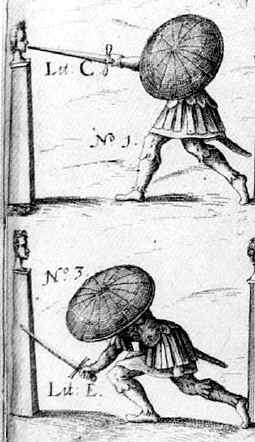
While some of these masters expanded
Liechtenauer’s text verbally, others sought to clarify the phases and
variations of different types of combat by using illustrations rather
than long descriptions. The pictographic method of MS. I.33 only
reappeared with the advent of printing, and the manuscript manuals
never adopted it to elucidate the art of the long sword. But, for the
historian, the loss of an easily read notation is more than out-weighed
by the recording of an abundance of postures, thrusts, cuts and
wrestling techniques; by a concern to depict footwork accurately; by
proper identification of target areas; and by the way in which the
whole system was firmly set within a coherent, all-embracing combat
philosophy. Essentially, the descriptive method boiled down to
providing a separate name for every conceivable fighting posture and to
illustrating these from a rich repertory of frozen action pictures – a
method which long remained the norm not only in Germany but elsewhere
in Europe. As a way of conveying information it was, without doubt,
cumbersome; and a modern reader might easily conclude that a system of
swordsmanship described in this fashion must have been correspondingly
inefficient, especially in view of the cannibalism of the German
manuscript tradition.
Yet any descriptive system of
movement, however well conceived, must inevitably be obscure to someone
unfamiliar with its conventions.
The truth of the matter is that,
considered as a corpus rather than as individual items, the German FechtbŸcher
are not at all obscure and they enable us to
recognize that Liechtenauer’s opaque verses concealed a martial art of
deadly seriousness and efficacy which was sufficiently communicable to
have occupied the energies of masters and their pupils for nearly three
centuries.
 But the
differences between the texts are as revealing as their similarities. But the
differences between the texts are as revealing as their similarities.
[Liechtenauer gives] the same
openings, counters, stances, the techniques for evading an opponent’s
blade, counters to be used when an opponent attacks first, the
principal cuts, engagements or binding with crossed swords, cuts at an
opponent’s hands; and advice on close grappling, including using the
pommel of one’s sword.
In all, of Liechtenauer’s original
211 lines dealing with the long sword, Pauernfeindt cites 166, every
one of which is omitted by the author of La Noble Science who
otherwise renders the sense of the German text with care. Evidently,
while the long-sword fighting of the German school was considered well
worth translating into French, its idiosyncratic nomenclature (ox,
plough, fool, from the roof, rage cut, crown cut, squint cut and so on)
was not. The Frenchman’s decision is understandable. But fanciful
terminology long remained the order of the day: and not only in
Germany. A colourful multiplicity of guards and blows was also
characteristic of the early Italian masters, first under German
influence and then continuing under its own momentum.
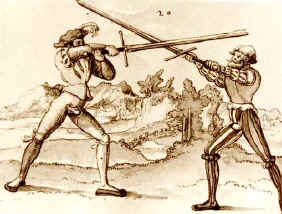
Marozzo, says ‘Every time’ that you
parry or are attacked you will always assume one of the above mentioned
guards.’ And this is the trouble. Many of the guards are obviously only
stages of one and the same movement and, as Viggiani was soon to point
out, it was possible to break everything up into an infinity of pieces.
It is this arbitrariness which makes it pointless to attempt to match
the blows and guards of the various masters who have left us a record
of their two-hand sword fighting. It is not difficult to find
similarities between many of the postures depicted in Fiore, Talhoffer,
DŸrer, Marozzo and others: but, when all is said and done, the
difference between many of the guards is too trifling to merit the
dignity of the separate titles which were accorded them.
The precise definition of the art of
fencing was something which never troubled medieval and renaissance
masters though it has bothered historians who want to establish the
origins of what they refer to as scientific fencing,
by which they mean modern sword play – with the emphasis on play. It
took centuries before the words fencing, Fechten,
escrime, esgrima, scrimia,
scherma and so on, came to indicate
exclusively the use of the single sword without any other weapon or
unarmed self-defence skills. Many medieval masters taught such
fighting, but it was only one of several martial arts in their
repertory and never the most important. They generally accorded primacy
to the long sword: and the use of that, as we have seen, was anything
but unscientific.
The
book also contains a wealth of rare and previously unknown material
from numerous Masters of Defence and their works.
Copyright © 2000 Yale University Press, All
Rights Reserved, Reprinted by Permission of the Author
|

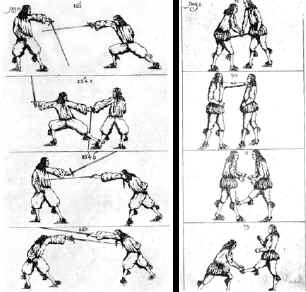 A
great many problems are involved here: the influence of historical,
military and civil fashion; the definition of what precisely
constitutes fencing; and debate concerning the use of point an edge,
general principles of fighting, the mechanics of movement, and the
psychology of combat."
A
great many problems are involved here: the influence of historical,
military and civil fashion; the definition of what precisely
constitutes fencing; and debate concerning the use of point an edge,
general principles of fighting, the mechanics of movement, and the
psychology of combat."