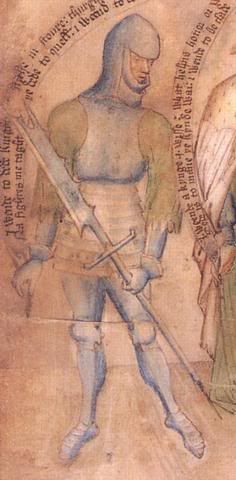
I want one of those SO BAD!!!!While I'm not sure what category it falls into, there is this strange looking weapon
It seems to be a mix between a bill and a falchion.

Steve;
The handle is 3ft, and the chain is longer than three feet?
 |
|||||||
|
|
|||||||
Moderators: Webmaster, Stacy Clifford

I want one of those SO BAD!!!!While I'm not sure what category it falls into, there is this strange looking weapon
It seems to be a mix between a bill and a falchion.

>That funny. I use to lay brick and can attest to a trowel getting sharp from use. You rarely need a brick hammer when you get good with your trowel. We would cut the aluminum wire about the thickness of a pencil with our trowel also.
Cool find.

When I worked as an archaologiest I use to keep my trowel extremely sharp. Likewise, our shovels were also very sharp. Before we would take new students to the field for the first time I would demonstrate to them what a very sharp shovel could do to a small tree. Students were always injurying themselves with shovels...but not with the sharp part.Archaeological trowels are often deliberately sharpened, since a sharp trowel makes it easier to handle finer details of excavation around discovered artifacts (which are often fragile) and visually enhance the boundaries between layers in the soil (when taking a stratigraphy photograph). The point is pretty sharp, too. I wouldn't want to be on the receiving end of one.

These swords are called Fecht- or Schwertfeder. As far as I know, their were former made by used swords with grinded edges. In later days their made specially for training purposes, their are very flexible so you can train some stabbing technics with a minimum risk. We use them in our lesson.
>When I worked as an archaologiest I use to keep my trowel extremely sharp. Likewise, our shovels were also very sharp. Before we would take new students to the field for the first time I would demonstrate to them what a very sharp shovel could do to a small tree. Students were always injurying themselves with shovels...but not with the sharp part.Archaeological trowels are often deliberately sharpened, since a sharp trowel makes it easier to handle finer details of excavation around discovered artifacts (which are often fragile) and visually enhance the boundaries between layers in the soil (when taking a stratigraphy photograph). The point is pretty sharp, too. I wouldn't want to be on the receiving end of one.
>the us martnes use the shovel or etool as a primary cqc weapon it was even on the terrible deadliest warrior anyway one swing nearly took the head of a balistics dunny clean off that impressed me i have to say

You'll see this unusual combat featured in the works of Hans Talhoffer. Weird stuff, that.They also have an illustration of an judicial duel between man and woman.
She have a stone in her scarf used as flail, he has a wooden club one hand tied behind his back and is standing in a hole dug to his midriff.
The club have been worked on a lathe and have a lens shaped head.
Return to “Research and Training Discussion”
Users browsing this forum: No registered users and 18 guests
|
|
|||
|
|
|||
|
|||
 .
.