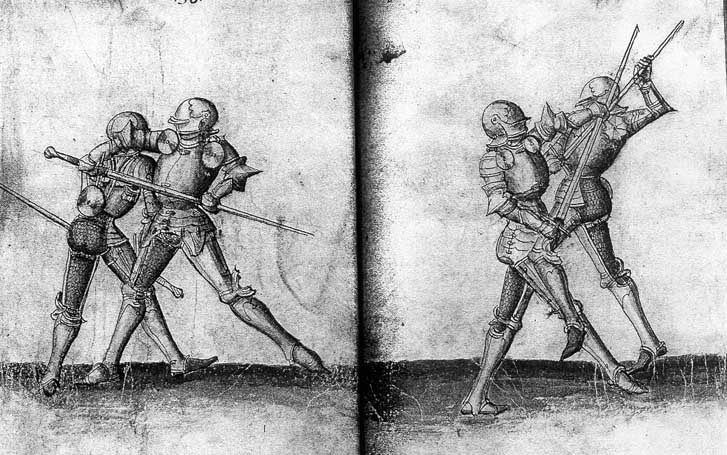
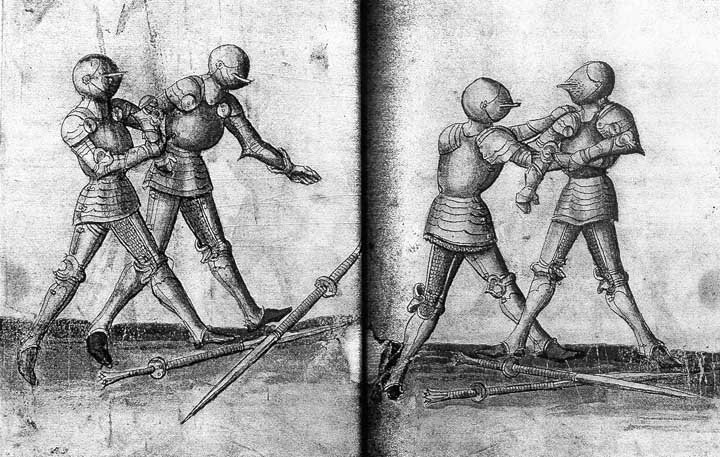
I'm struggling to accept that half swording and sharp swords go together, and am wondering what the experts have to say, especially having noticed John Clements cutting with a 'blunt'
I have heard various explanations about gripping the blade 'just so' in order to keep the hands safe, but it seems to me that in a fight it is likely that the hand could slip up or down the blade and slice the fingers.
I really want to know whether or not to assume that half swording is an occasional carefully executed technique performed with a sharp sword (unlikely ?), or if it is a regular technique which can be performed with confidence and strength while grasping a blunter blade firmly.
It makes the world of difference to where my training goes from here, help will be much appreciated.
Regards to all
Roy
PS I have read some of the discussion here on the subject but it seemed inconclusive, and a lot of the illustrations I have seen show the blade grasped firmly quite close to the tip, which seems to refute the idea of differential sharpening. . . what I don't like is a sort of compromise notion where half swording is done in training with blunts but isn't really possible with the 'real deal' sharps. .. . I want to train to use the real weapon.
Also, I'm not buying the hand callous/gauntlet argument, a really sharp blade will surely slice callouses and gauntlets just as well as regular skin
.
.
 |
|||||||
|
|
|||||||