Moderators: Webmaster, Stacy Clifford
The maximum speed of the cut is determined by the ability of the user to accelerate the weapon from rest. This maxes out long before air resistance becomes a limiting factor.In order to get a feel for the sort of air resistance generated by a wide blade which is stalled ( keeping in mind that tubercules reduce drag even when not stalled ) one can swing a lightweight wooden staff or batten with a similar width. A flat sided batten will work best.
In doing so it's immediately apparent that the maximum speed of the cut is determined by air resistance.
We are hardly ever talking about continuous circular arcs. You change the direction of the arc with almost every cut. You may give two cuts in a row, but that is about it. The change in direction of the cut is what burns energy. You are applying force in a direction tangential to the direction of motion. Except that since the motion is circular, the direction at which you apply force is constantly changing. And we are not talking about spinning a rope with a ball on the end of it. You are applying force at two different points, your two hands, torquing the weapon--applying opposing forces--instead of simply swinging it--providing just enough force to keep it in motion. And you are stepping. And your abs and core are counteracting every motion you do. It's exhausting just writing about it!Once a sword is in a continuous circular arc motion ( excluding air resistance ) it takes a lot less energy to keep it in motion than it does to accelerate it in the first place. Thus continuous arcs are not necessarily very tiring, as long as the air resistance is low.
Here, I might concede to you that air resistance could be a factor, because I don't know how fast you are twirling the stick. Why the heavier is easier than the lighter might be a function of mass. The heavier one has more momentum that resists declaration than the lighter one. You have to supply more force yourself to keep the lighter one at similar speeds. But in ARMA, we don't do whirling drills. We make cuts, thrusts, and attacks. So I hardly think this example is relevant to using a sword with two hands.Air resistance is the catch. Air resistance saps energy very quickly. I've found this also with shorter weapons. For example it is less tiring to do fast whirling staff escrima drills with thin heavy sticks than it is with thicker lighter sticks. When such drills are done slowly the lighter thicker sticks are much easier to use, but once going fast air resistance soon limits the top speed. . . and that's when doing very tight small radius arcs spirals figure eights and so on, it's even more the case with longer weapons. With simple strikes where the weapon travels through a shorter arc ( e.g 90 to 180 degrees ) this isn't as apparent, the lighter stick feels faster as the limiting factor then is inertia during acceleration.
The maximum speed of the cut is determined by the ability of the user to accelerate the weapon from rest. This maxes out long before air resistance becomes a limiting factor.In order to get a feel for the sort of air resistance generated by a wide blade which is stalled ( keeping in mind that tubercules reduce drag even when not stalled ) one can swing a lightweight wooden staff or batten with a similar width. A flat sided batten will work best.
In doing so it's immediately apparent that the maximum speed of the cut is determined by air resistance.
Of course in your two man duelling scenarios with longswords you don't use continuous arcs.We are hardly ever talking about continuous circular arcs. You change the direction of the arc with almost every cut.Once a sword is in a continuous circular arc motion ( excluding air resistance ) it takes a lot less energy to keep it in motion than it does to accelerate it in the first place. Thus continuous arcs are not necessarily very tiring, as long as the air resistance is low.
I think that you are confusing a judicial duel scenario with the one against many scenarios described in the historical sources. . . . and in which 'two cuts' is unlikely to be sufficient
You may give two cuts in a row, but that is about it.
With even a 50 inch staff the air resistance is the predominant factor limiting speed in any wide seeping continuous cutting motions which travel through 360 degrees as required by the martial 'one against many' scenario we are discussing.
Here, I might concede to you that air resistance could be a factor, because I don't know how fast you are twirling the stick.Air resistance is the catch. Air resistance saps energy very quickly. I've found this also with shorter weapons. For example it is less tiring to do fast whirling staff escrima drills with thin heavy sticks than it is with thicker lighter sticks. When such drills are done slowly the lighter thicker sticks are much easier to use, but once going fast air resistance soon limits the top speed. . . and that's when doing very tight small radius arcs spirals figure eights and so on, it's even more the case with longer weapons. With simple strikes where the weapon travels through a shorter arc ( e.g 90 to 180 degrees ) this isn't as apparent, the lighter stick feels faster as the limiting factor then is inertia during acceleration.
It's a simple matter of air resistance. If the sticks are of the same diameter but different weights, the the heavier ones will always be slower.
Why the heavier is easier than the lighter might be a function of mass. The heavier one has more momentum that resists declaration than the lighter one. You have to supply more force yourself to keep the lighter one at similar speeds.
This is the crux of the objection, but is based on faulty logic.
But in ARMA, we don't do whirling drills. We make cuts, thrusts, and attacks. So I hardly think this example is relevant to using a sword with two hands.
Many of the two handers have spatulate tips, so thrusting was probably a secondary use. The wide bladed spatulate tipped two handers are primarily cutting weapons.
I suppose you can swing it, but when delving into pike formations I get the impression that they are changing to a half-sword like technique. They are using it more like a spear, but one that can cut along it's full length.
Many of the undulating blades had very high frequency undulations wich would definitely make it harder to thrust in or out of a body.. . their tips are also clearly not designed for thrusting deeply, certainly not three feet deep !
the wave may aid in get the blade in and out of a body (guessing)?
But the staff has a lot more air resistance than a blade swung to cut, relatively edge-on (even if edge alignment is not perfect all the way around the arc).With even a 50 inch staff the air resistance is the predominant factor limiting speed in any wide seeping continuous cutting motions which travel through 360 degrees as required by the martial 'one against many' scenario we are discussing.
The staff has LESS air resistance than a stalled blade of similar width.
Hello Vincent,But the staff has a lot more air resistance than a blade swung to cut, relatively edge-on (even if edge alignment is not perfect all the way around the arc).With even a 50 inch staff the air resistance is the predominant factor limiting speed in any wide seeping continuous cutting motions which travel through 360 degrees as required by the martial 'one against many' scenario we are discussing.
The staff has LESS air resistance than a stalled blade of similar width.
The Montante trainer is extremely narrow, the fact that little air resistance is felt with it even when stalled at speed is hardly suprising and supports what I've been saying. It's not a good example of a thin, wide, two handed cutting sword . It does not resemble a wing as wide cutting blades do.
I know the feeling one can get when air resistance becomes predominant, it's what you get when you swing for example a pool noodle around: instead of letting it swing you have to push it all through the arc just to keep its speed. If let on its own it slows down very quickly.
I have never had that feeling with steel swords, even blunt, even straight. They feel like they have plenty enough energy to keep moving even though air resistance is there and even if you don't push them at all. I've played a bit with my Montante trainer this week. It never felt like air resistance was a limiting factor, while mass certainly was. Also, it makes very little noise when swung, even with direction changes made to deal with 360° fights; I suppose if there was a significant amount of turbulence due to stalling it would be heard?


Actually I'm not completely convinced yet that the kind of undulations we see on sword blades give an aerodynamic advantage, because they do not look exactly like those that were shown to have that effect (in particular in terms of undulation frequency vs. 'wing' width). Another issue is indeed whether an aerodynamic advantage is necessary or significant at all, which could make the first point moot.It's not possible to deny that undulating blades ( whatever else they do ) give an aerododynamic advantage in wide cutting blades , as the laws of physics dictate that it is so. The only issue is how large that advantage is.
Can't speak for ARMA as I'm not a member but there clearly were decorative elements even on blades. A psychologic effect is functional as well; not everything is physics in martial arts (as I think a recent ARMA article discussed).The ARMA philosophy ( as far as I understand it ) is that the Renaissance sword makers and users were intelligent masters of their arts, and that every aspect of their swords was designed for functional martial reasons . Given that this is the case the current state of the ARMA lore ( in the archives at least ) regarding undulating blades ( that they are there to look scary but serve no practical purpose ) contradicts the ARMA philosophy.
In wind tunnel tests undulation frequency was found to have very little effect on the results. Amplitude has a bigger effect, and there is a an enormous range in terms of tubercule amplitude and frequency ( as well as differences in shape ) which show beneficial results.Actually I'm not completely convinced yet that the kind of undulations we see on sword blades give an aerodynamic advantage, because they do not look exactly like those that were shown to have that effect (in particular in terms of undulation frequency vs. 'wing' width). Another issue is indeed whether an aerodynamic advantage is necessary or significant at all, which could make the first point moot.It's not possible to deny that undulating blades ( whatever else they do ) give an aerododynamic advantage in wide cutting blades , as the laws of physics dictate that it is so. The only issue is how large that advantage is.
The fact is that blade undulations will give an aerodynamic advantage even if they look nice. . . in fact in swords good looks are usually the result of function not the other way around, also I doubt if blade geometry would be changed at big expense just for looks in battle weapons.Can't speak for ARMA as I'm not a member but there clearly were decorative elements even on blades. A psychologic effect is functional as well; not everything is physics in martial arts (as I think a recent ARMA article discussed).The ARMA philosophy ( as far as I understand it ) is that the Renaissance sword makers and users were intelligent masters of their arts, and that every aspect of their swords was designed for functional martial reasons . Given that this is the case the current state of the ARMA lore ( in the archives at least ) regarding undulating blades ( that they are there to look scary but serve no practical purpose ) contradicts the ARMA philosophy.
That's true.
Your theory does not explain either why there were other swords, rapiers and daggers with undulating blades
You might be assuming that the influence went from dagger and rapier to two hander, not the other way around. Rapiers and daggers are items of dress as well as weapons so are possibly more subject to fashion ( i.e. copying the mighty two handers of battle fame ) than expensive swords used by soldiers.
as pointed out before. If the reason for that was not physical functionality then why couldn't it be the case for two-handers as well?
I'm not talking about longswords and I'm not talking about dueling. I'm talking about making large circular and continuous cuts with a doppelhander. So everything here about me not understanding because I'm thinking about dueling or about longswords is rubish.I'm not talking about the stop/start relatively short cuts with thrusts technique used in longsword duelling, but of large sweeping cuts through 360 degrees
Longsword duelling is not the be all and end all of Renaissance sword arts.
Of course in your two man duelling scenarios with longswords you don't use continuous arcs.
I'm talking about controlling 360 degrees of space against multiple opponents using a wide bladed two hander as desribed in historical sources. . . it's a different discipline.
No. No, I'm not. I'm talking about not standing and cutting the same cut more than twice in a row. You cut to different openings, different lines of attacks. You don't sit there and just swing the sword in the same circle over and over again. You vary the strike.I think that you are confusing a judicial duel scenario with the one against many scenarios described in the historical sources. . . . and in which 'two cuts' is unlikely to be sufficientYou may give two cuts in a row, but that is about it.
Not at all. Not at all. We don't take sticks and do whirling drills because that's not how swords of our period of study, including dopplehanders, were used. If you want to do that with sticks, fine. Go ahead. But cutting continuously in circular arcs with dopplehanders is not analogous to whirling drills. To restate, we don't do whirling drills because there is not historical evidence for them.This is the crux of the objection, but is based on faulty logic.Here, I might concede to you that air resistance could be a factor, because I don't know how fast you are twirling the stick...Air resistance is the catch. Air resistance saps energy very quickly. I've found this also with shorter weapons. For example it is less tiring to do fast whirling staff escrima drills with thin heavy sticks than it is with thicker lighter sticks...
But in ARMA, we don't do whirling drills. We make cuts, thrusts, and attacks. So I hardly think this example is relevant to using a sword with two hands.
Arma concentrate on two man duelling scenarios.
The scenarios I am investigating are of one against many opponents, as desribed in historical texts, and they do involve bigger more continuous cutting motions through 360 degrees. . . exactly the sort of thing which isn't beneficial in a duelling situation.
They are nevertheless legitimate techniques for investigation.
The faulty logic you have applied is as follows: You state that because ARMA do not do 'whirling' drills that they therefore have no relevance to two handed swordsmanship. That is putting the cart before the horse, as historical examples come first.
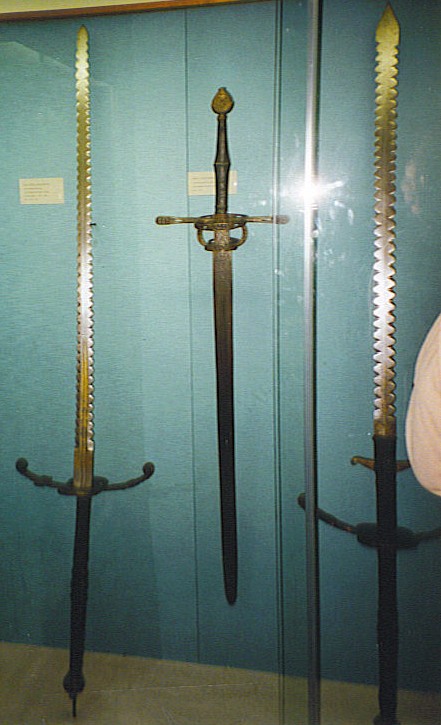
Some aspects were purely decorative. Some swords were purely decorative. Of the three the museum swords in the pic you posted, I'm not sure that any of them were intended for functional use. This undulating blade form did not emerge based upon technological adaptation due to changing blade forms in terms of larger and larger blades. We know this because it was applied across the same time period to a wide variety of sword lengths, including most importantly, foyning rapiers. Or course rapiers don't move through air anything like how a dopplehander does. Rather, the emergence of undulating blades is a stylistic device. They were put on swords as decoration, especially on the sword that was meant increasingly for show and decreasingly for function, the dopplehander.The ARMA philosophy ( as far as I understand it ) is that the Renaissance sword makers and users were intelligent masters of their arts, and that every aspect of their swords was designed for functional martial reasons . Given that this is the case the current state of the ARMA lore ( in the archives at least ) regarding undulating blades ( that they are there to look scary but serve no practical purpose ) contradicts the ARMA philosophy.
I beg to differ.
Not at all. Not at all. We don't take sticks and do whirling drills because that's not how swords of our period of study, including dopplehanders, were used.
There is historical evidence for the kind of cuts we are describing, but regardless of that whenever a blade is at speed and turns it operates at a positive angle of attack and will benefit from tubercules.
If you want to do that with sticks, fine. Go ahead. But cutting continuously in circular arcs with dopplehanders is not analogous to whirling drills. To restate, we don't do whirling drills because there is not historical evidence for them.
Just because the undulating form appeared suddenly in European swords does not mean that it was therefore a decorative addition. Many technological advances occur suddenly as the result of inspiration or serendipitous events.
Some aspects were purely decorative. Some swords were purely decorative. Of the three the museum swords in the pic you posted, I'm not sure that any of them were intended for functional use. This undulating blade form did not emerge based upon technological adaptation due to changing blade forms in terms of larger and larger blades. We know this because it was applied across the same time period to a wide variety of sword lengths.
This is a faulty argument: It doesn't follow that the differences in handling between rapiers and wide blades two handers entail that undulations are merely stylistic, as they could easily have been adopted on rapiers in imitation of the new breakthrough in two handed battle swords. Furthermore the wavy blades on rapiers would still give an advantage when he blade is swung from side to side as sometimes happens.
Or course rapiers don't move through air anything like how a dopplehander does.
Rather, the emergence of undulating blades is a stylistic device.
This is your opinion, but as far as i know you can't prove it.
They were put on swords as decoration, especially on the sword that was meant increasingly for show and decreasingly for function, the dopplehander.
Interesting facts - thanks.Many of the two handers have spatulate tips, so thrusting was probably a secondary use. The wide bladed spatulate tipped two handers are primarily cutting weapons.I suppose you can swing it, but when delving into pike formations I get the impression that they are changing to a half-sword like technique. They are using it more like a spear, but one that can cut along it's full length.
Charging into Pike formations is one scenario desribed, another is defence of a position against many opponents e.g. defending the standard
Many of the undulating blades had very high frequency undulations wich would definitely make it harder to thrust in or out of a body.. . their tips are also clearly not designed for thrusting deeply, certainly not three feet deep !the wave may aid in get the blade in and out of a body (guessing
Return to “Research and Training Discussion”
Users browsing this forum: Amazon [Bot], Google [Bot] and 184 guests
|
|
|||
|
|
|||
|
|||