http://www.thearma.org/arttalk/at44.htm
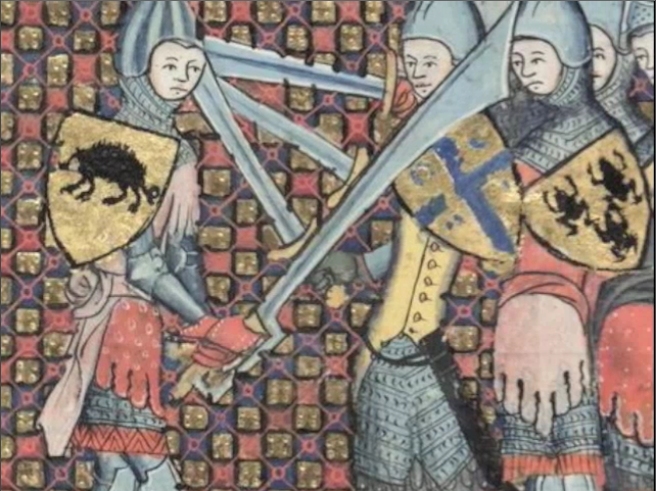
(Look in the background of the top panel.)
 |
|||||||
|
|
|||||||
Moderators: Webmaster, Stacy Clifford
Swords would have to be A LOT better than guns at dealing trauma to make them primary.

Good question, I'm starting to wonder myself.I was going ask which is more important to you, the armor or the sword?

There's a great deal that you could extrapolate from similar situations that realistically happened in history. One of the things that comes to mind is the introduction of the tank in World War I. Early tank armour was necessarily quite thin since the engines available could not propel a much heavier vehicle to a reasonable turn of speed. As a result, the Germans experimented with special kinds of rifle rounds (among them ones where the projective was reversed so that it struck with the blunt end first) that proved capable of penetrating tank armour at long range. Pretty much all sides also began to develop anti-tank rifles of a size and power comparable to modern anti-materiel rifles; I suspect that similar weapons would have been an important development priority in a Civil War milieu with armour that could resist ordinary musket balls. Perhaps they would have taken a form similar to early wall guns (search for the German term "Doppelhaken" or Eastern jingals, probably crewed by two soldiers rather than one. The impact of the large bullets from such a weapon would have been equivalent to (at least) a strong blow from a stout warhammer and they would have allowed properly-equipped teams to engage armoured troops from a much longer range, than, say, an extra-heavy revolver firing the equivalent of shotgun slugs (Le Mat, anyone?)Speculation: a firearm of mythril-bashing caliber would probably have to be a two-hander. Give it a bayonet, and maybe even a hook--you could fashion a polearm out of it, adding close-range options to armored combat. Using it for melee may damage the firing mechanics (that's part of the game). Mythril's strong enough that bashing would do little good, but maybe you can thrust between what little gaps the Maximilian-esque armor has, or fire point-blank for increased lethality...I'm just rambling off the top of my head, but this might work.
Maybe you should consider a different dimension to the complexity and intricacy of war. Firearms didn't really make war simpler and more brutal as such; while gunpowder warfare may have required less skill in individual handling of arms, gunpowder armies actually required more training than earlier ones since the characteristics of their weapons as well as the larger numbers of soldiers involved meant that teamwork had become more important than ever. If your character was a low-ranking officer, why not show her skill in leadership and tactics? Go read Bernard Cornwell's Sharpe series if you need to convince yourself that such things could work. Sharpe does get into a large number of swordfights throughout his fictional career, mind you.What I like about swords is that its art is complex, intricate, subtle--a deep game, far more than gun warfare. The samurais must have been devastated when any peasant could pick up a gun and render worthless their lifetime of training. (It's a shame Hollywood wastes its intricacies though--there's so much untapped potential in it. One of my all-time favorite movie fights is the climactic duel in Troy--you can feel the strategy behind it, the depth of the game. Too often I'll be caught in the illusion of a movie until the fight scenes, but that Troy scene's believability did wonders for the drama, the intensity of the scene for me. That's so much more than "cool factor.")
Return to “Research and Training Discussion�
Users browsing this forum: No registered users and 36 guests
|
|
|||
|
|
|||
|
|||