
|
||||||||
|
|
||||||||
| The
ARMA System for Historical Fencing Study Man
muss fleissig nachdencken ("you must study this diligently")
-
the 15th century German Masters of Defence
|
||||||
|
"Real World Skills From Real History" Our Renaissance fencing skills are not a chivalric fantasy sport, duelling game, or re-creational role-playing amusement but a modern combative discipline. This is no "pose and prance" approach, and no pretentious play and display attitude.
In
this approach to exploring lost fighting arts we first look for commonalities
in the source literature; seeking understanding of underlying elements
in order to learn about the overall nature of the craft. Then we next
begin to focus on specific sources or teachings noting their
unique aspects, looking for any contrasts in style or philosophy from
others. The ARMA means of study is to explore, to question, to examine, to execute movements and actions with vigor, then “rewind” them, repeat them, and re-analyze. This system is a "tool" that allows students to teach themselves by using materials from the source manuals as examples and as “puzzles” to work through, always keeping in mind the lethality and intent of the historical techniques. We have been advocating and teaching this method as a combative discipline for a long time and it works.
The Skills Proficiency Certification for ranking within the ARMA consists of examinations for competency in foundational techniques and knowledge base in the discipline of historical fencing studies. The ARMA revises and amends its knowledge base and interpretations as new information and material comes to light. The ARMA's longsword curriculum provides the foundation of study and is made up of: fundamental drills and basic exercises, core practice routines, free-play (contact-sparring), and test-cutting.
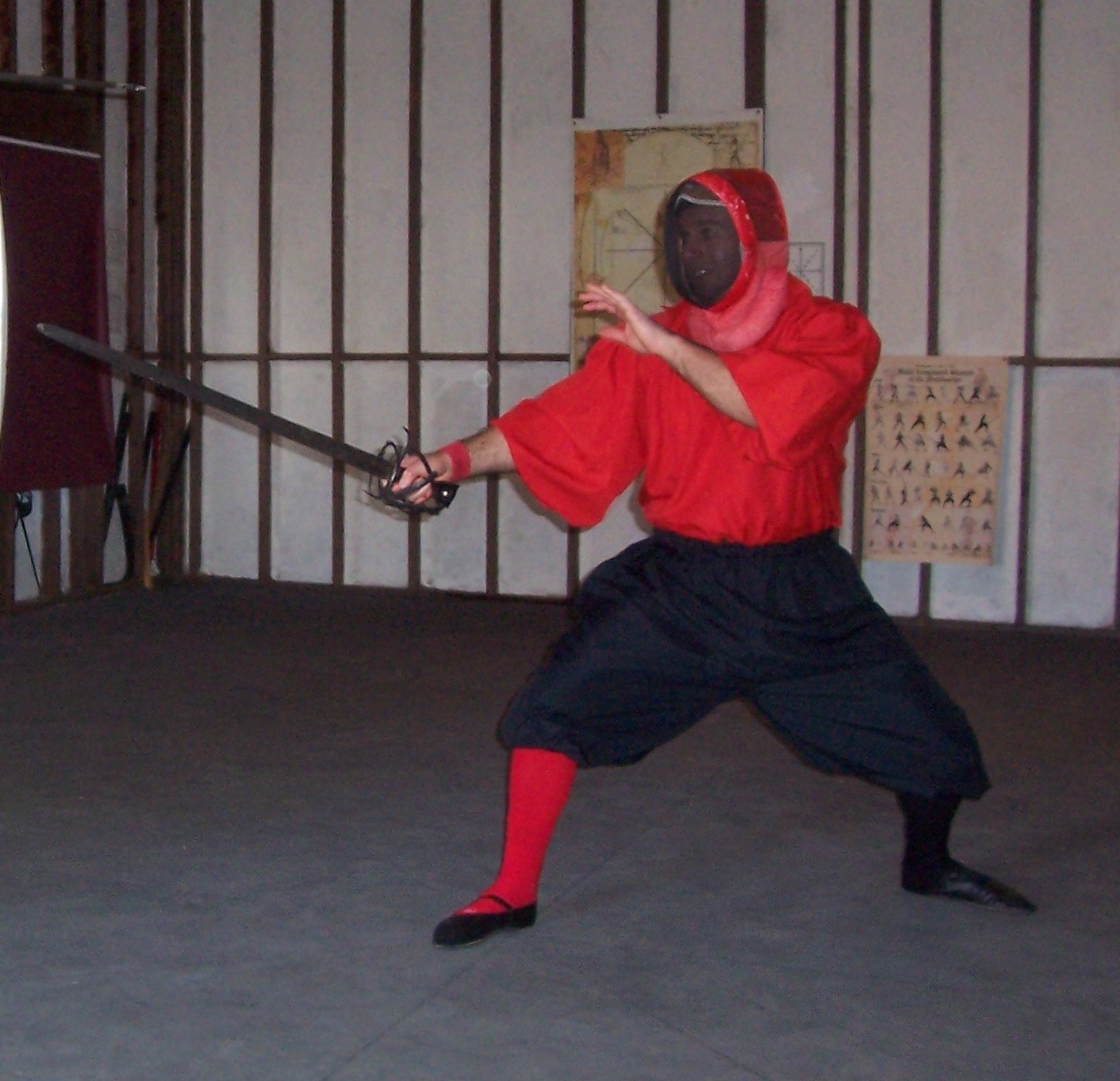
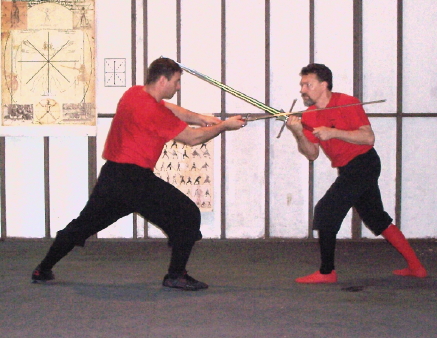
The ARMA system of exploring real techniques also places emphasis on proper intent –i.e., learning and executing moves with realistic speed and range in order to acquire a correct sense of counter-timing, balance, and motion. ARMA stresses a “martial” approach to this subject –by this we mean emphasizing that these skills and techniques were intended to be used with force to cause injury –even though we never use them for this. To be relearned properly today it is only logical that they must –must– be performed in earnest, with energy and speed and we must make the effort to practice them in this way. (Going slow and soft only teaches you to go slow and soft) This kind of dynamic doesn't come at first and has to be developed over time. The degree to which each student achieves it may vary. While other organizations may focus more on the pageantry and role-playing of knightly tournaments or on the “deportment” of proper “technical exchanges” within a conception of gentlemanly duels, the ARMA does not. Although these may be semi-historical approaches, we feel such things are more ritual than martial, and more ritual combats of the period were far outweighed by real fighting. Thus, one of the things we try to inspire in modern students is a realistic appreciation of the martial content of the subject we study. We therefore place value on the mental or psychological aspects as well as the physical or technical. The ethical component of the craft is not ignored either. For both Medieval and Renaissance weapons and sword training what ARMA students normally do is fairly simple yet sophisticated and detailed. Beyond our proprietary lesson program and original insights, there is nothing "secret" or "special" really, just plenty of hard training, intensive study, and emphasis on free-play using our inclusive guidelines.
|
||||||
|
From the beginning we proceeded on the assumption that the material and information presently known was only a small portion of what would eventually become available. We therefore consciously endeavored to have our practice and teaching curriculum make room for future advancements in the subject. In this way, as new information and translations become available they can with small effort be fitted into our curriculum. Rather than limiting ourselves to examination of one or two specific source works – certainly a valid approach that allows for a deeper study of each particular title –we instead used contrast and comparison of the widest possible range of historical texts to supplement and augment one another. Our Philosophy of Training and Teaching
with Intent: If historical self-defense methods are to be established as functional and effective under conditions of violent force, they must logically be shown-at some point during instruction-with something more than hypothetical slow motion sequences. Simply "going through the motions" of a fighting technique isn't sufficient to either evaluate it or develop it as an effective action. It is certainly acceptable to move with deliberate caution and careful control when doing initial analysis, when first teaching new students, or when practicing with novices, but the eventual goal must be to execute actions with earnest intent -assuming your goal is actual skill in the reconstruction of a genuine combative system. It surely gives no credibility or legitimacy to this subject for those claiming expertise to fail to perform with expertise. The use of controlled force in this very way is itself a sure sign of higher skill. Our emphasis on intent is also directly in keeping with what we see as the four key components of research into historical fencing methods: transcription, translation, interpretation, and application.
|
||||||
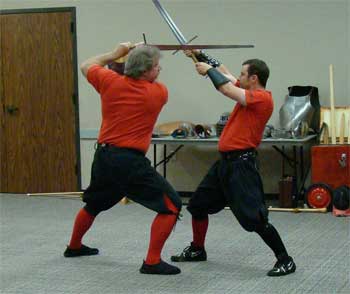 Understanding
the nature of these fighting methods of self defense cannot be accomplished
only through arranged drills and exercises. To explore and reconstruct these
historical teachings and methods requires developing skill in performing
them spontaneously through free play (sparring) conducted with proper intent
and energy. The craft cannot pursued legitimately or credibly when
reduced to a mere sportified activity that dilute its inherent violence
into a gaming contest. Understanding
the nature of these fighting methods of self defense cannot be accomplished
only through arranged drills and exercises. To explore and reconstruct these
historical teachings and methods requires developing skill in performing
them spontaneously through free play (sparring) conducted with proper intent
and energy. The craft cannot pursued legitimately or credibly when
reduced to a mere sportified activity that dilute its inherent violence
into a gaming contest.As practice-fight, sparring is about safe realistic application of effective teaching under adversarial conditions for the purpose of combat preparation. When performed as a vigorous exercise, contesting with others provides vital feedback to the fighter. And doing so with good camaraderie and martial spirit is undeniably fun for practitioners. But recreational amusement was not the goal of the activity --- nor was merely executing an ideal technical form or some personal aesthetic. Form comes from the motion of effective function and in real life and death encounters effective techniques by their nature require good form. They don't require restrictions for safety, as in classroom practice, or rules for scoring as in sporting contests. 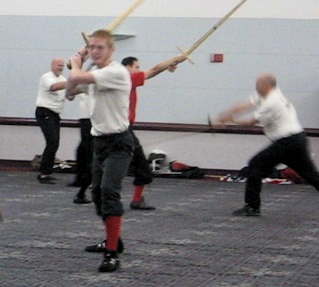 It
is not hard to notice that those who dismiss sparring as a vital tool for
learning martial arts (or a means of judging self-defense ability), notoriously
perform the poorest when engaging in it or are frequently the least capable
of physically conducting it. Instead, they invariably advocate practice
that consists of little more than arranged drills and seldom demonstrate
anything more than dancing "katas" --- neither of which are prominent within
the source teachings or historical accounts of Renaissance martial arts.
It is a common sense truth that if you cannot perform well under mock conditions,
you cannot claim you would do better if only the conditions were real. It
is not hard to notice that those who dismiss sparring as a vital tool for
learning martial arts (or a means of judging self-defense ability), notoriously
perform the poorest when engaging in it or are frequently the least capable
of physically conducting it. Instead, they invariably advocate practice
that consists of little more than arranged drills and seldom demonstrate
anything more than dancing "katas" --- neither of which are prominent within
the source teachings or historical accounts of Renaissance martial arts.
It is a common sense truth that if you cannot perform well under mock conditions,
you cannot claim you would do better if only the conditions were real.The evidence for assorted forms of mock combat practice as a means of training knights and ordinary fighting men in the Medieval and Renaissance eras is incontrovertible. And the requisite physicality of doing so credibly is self-evident. For serious students of the craft there is simply no ignoring this. |
||||||
|
See also: |
||||||
|
|
|||
|
|
|||
|
|||
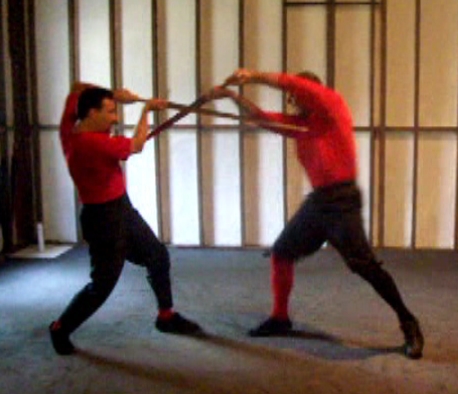
 The
real historical teachings and arms are our guide. We neither
make it up on our own nor simply “borrow” from
popular Asian martial arts or modern sport fencing. Our
own historical sources are too rich, diverse, and sophisticated
in their methods to need to bother.
The
real historical teachings and arms are our guide. We neither
make it up on our own nor simply “borrow” from
popular Asian martial arts or modern sport fencing. Our
own historical sources are too rich, diverse, and sophisticated
in their methods to need to bother. 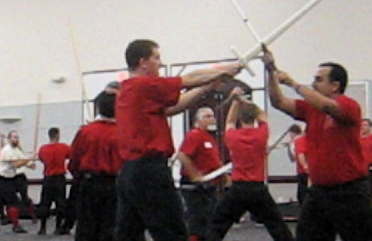
 The
proof is in the quality of fighters we produce. Yet, we actively seek
to avoid producing students
that are technically proficient in movement patterns yet tactically ineffectual
as fighters. We seek the meaning of these teachings…and through
analysis, a modern way to safely practice them once again. When it comes
to Renaissance martial arts, we concluded, authenticity does not exist
unless we now reconstruct it.
The
proof is in the quality of fighters we produce. Yet, we actively seek
to avoid producing students
that are technically proficient in movement patterns yet tactically ineffectual
as fighters. We seek the meaning of these teachings…and through
analysis, a modern way to safely practice them once again. When it comes
to Renaissance martial arts, we concluded, authenticity does not exist
unless we now reconstruct it. 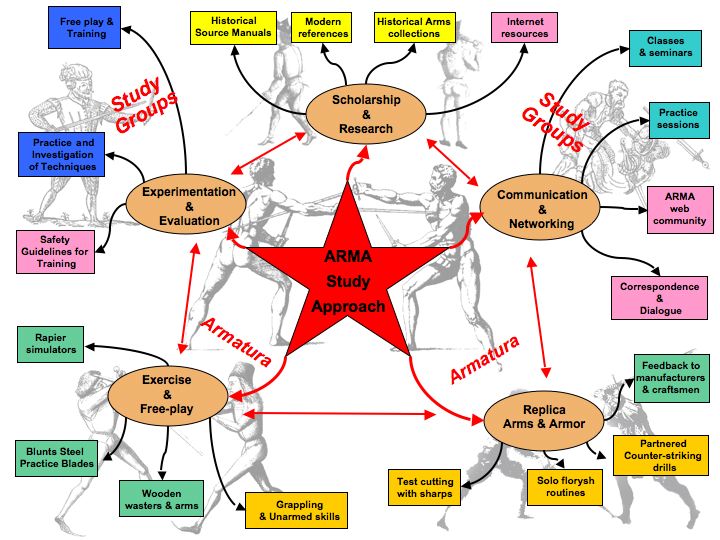
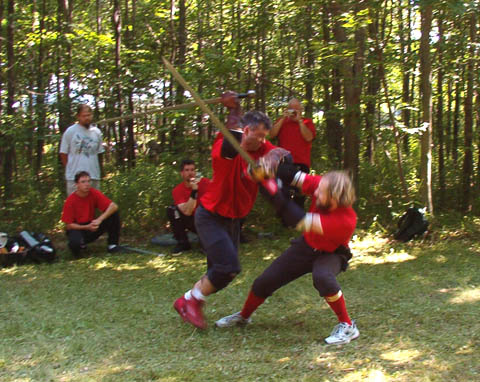
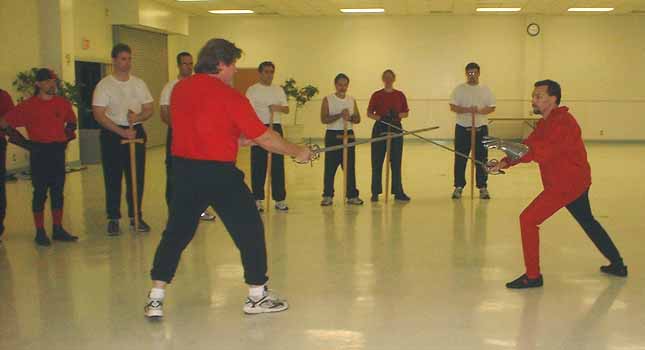
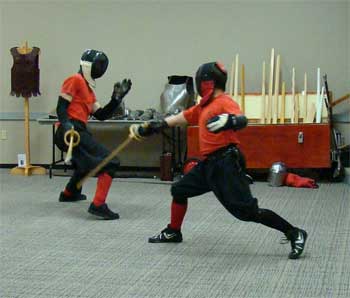 Over
time, intent (range, speed and power) is increased to more and
more earnest levels. Safe free-play / sparring is conducted
with controlled force but with realistic martial intent (speed
and contact) using wooden wasters or blunt training blades.
Sharps are used for some occasional cutting experience.
Over
time, intent (range, speed and power) is increased to more and
more earnest levels. Safe free-play / sparring is conducted
with controlled force but with realistic martial intent (speed
and contact) using wooden wasters or blunt training blades.
Sharps are used for some occasional cutting experience.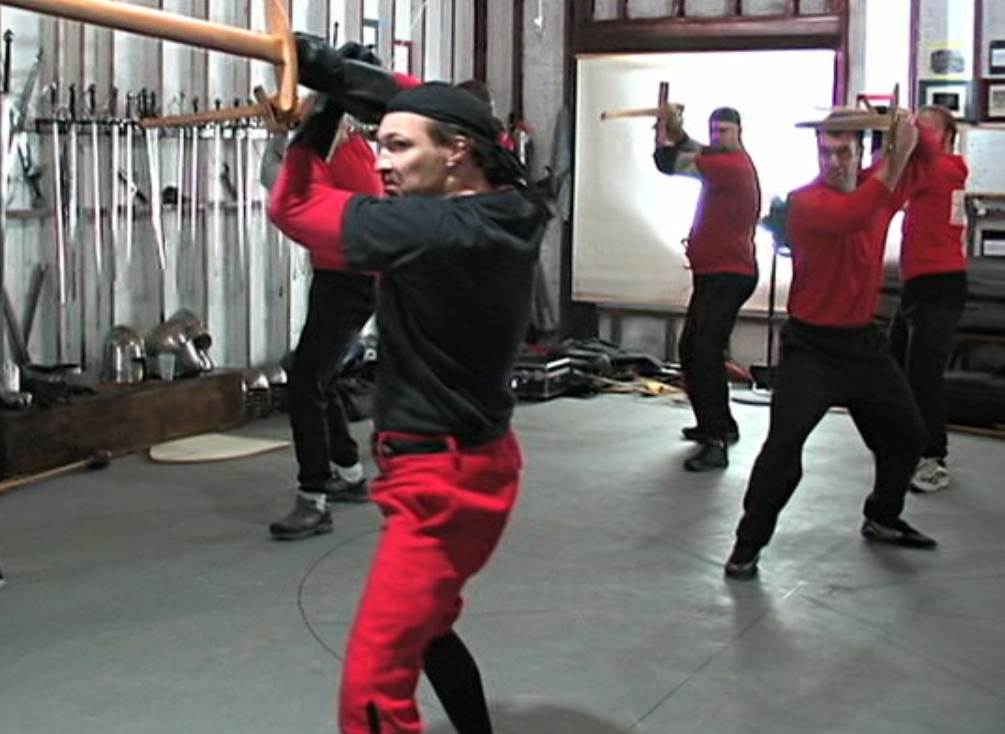
 The
techniques of Renaissance martial arts were meant to protect an individual
from being attacked with deadly speed and force. Historically, it was
imperative they were understood in this context and they were surely taught
to students in this way. The only way to communicate authority in interpretations
of these methods and techniques is through energetically displaying competence
in their physical application and doing so in a manner that demonstrates
their martial validity.
The
techniques of Renaissance martial arts were meant to protect an individual
from being attacked with deadly speed and force. Historically, it was
imperative they were understood in this context and they were surely taught
to students in this way. The only way to communicate authority in interpretations
of these methods and techniques is through energetically displaying competence
in their physical application and doing so in a manner that demonstrates
their martial validity. 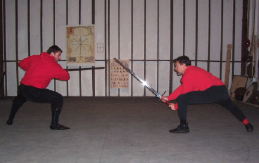 In
order to provide a broad general understanding of fighting arts from the
Medieval and Renaissance periods we include in our research all
European fighting manuals up to the late 17th century.
In
order to provide a broad general understanding of fighting arts from the
Medieval and Renaissance periods we include in our research all
European fighting manuals up to the late 17th century.